
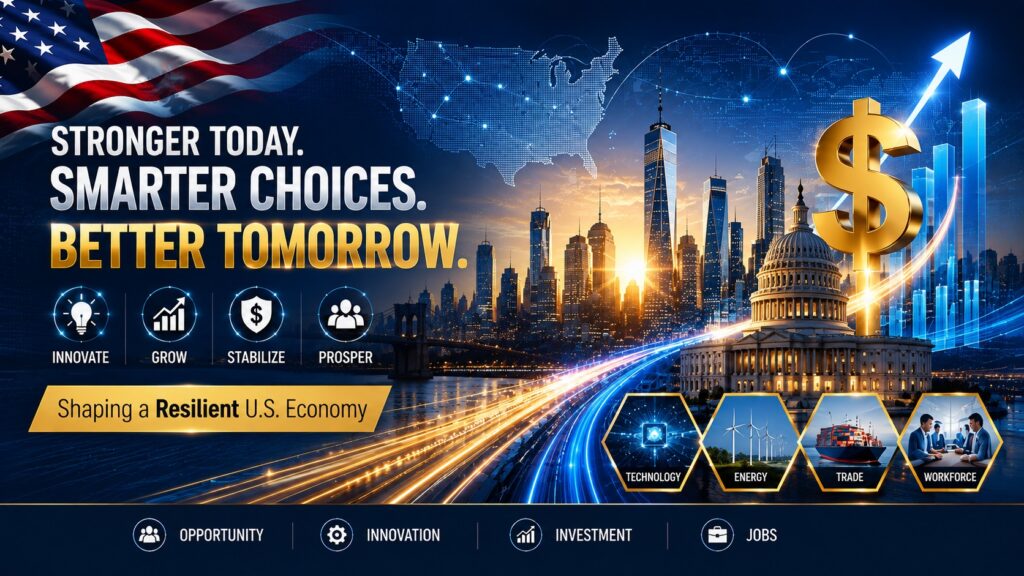
Collection curates data-backed analysis, trend forecasts, and expert commentary on where the American economy is headed over the next several years. From artificial intelligence reshaping entire job categories to shifting trade policy, interest rates, and consumer spending patterns, this collection breaks down the forces that will define business, investment, and everyday financial life through 2030. We built this collection for readers who want more than headlines professionals tracking labor market shifts, investors weighing where capital will flow next, small business owners planning around changing costs, and everyday Americans trying to understand what rising productivity, automation, and policy change actually mean for their paycheck and their future. Each piece draws on economic forecasting from sources like the Federal Reserve, McKinsey Global Institute, and major financial research desks, translated into plain language without the jargon or the hype. You’ll find grounded takes on GDP growth projections, the AI productivity question, tariff and trade shifts, housing affordability, and what a shrinking labor force means for wages. This is forecasting with context, not speculation dressed up as certainty. Explore the collection below, and read on for the full breakdown of how the next few years could reshape your industry, your investments, and your household budget.
The Big Economic Forces Shaping 2030
Three structural forces are doing most of the work behind every 2030 forecast: artificial intelligence adoption, an aging and slower-growing labor force, and a federal debt load that keeps climbing relative to GDP. Recent economic research points to real GDP growth settling in a moderate 2.0%–2.6% range through the back half of the decade, assuming AI-driven productivity gains actually diffuse beyond tech and finance into manufacturing, logistics, and back-office operations. That’s a meaningfully different story than the stagnant, low-productivity 2010s. At the same time, reshoring of manufacturing, semiconductor investment, and energy infrastructure spending are pulling capital back into the U.S. in ways that hadn’t been seen in decades. None of this happens in a straight line — most forecasts still expect at least one mid-cycle slowdown before 2030, driven by lagging effects of tighter monetary policy and swings in oil prices and tariffs.
Jobs, Wages, and the AI Effect
The labor market by 2030 looks less like mass unemployment and more like mass reshuffling. Early data already shows measurable efficiency gains in customer service, marketing, software development, and administrative work — the roles most exposed to large language models and automation. That doesn’t mean those jobs disappear overnight; it means the same output gets produced with fewer people, while entirely new categories of work emerge around AI oversight, data infrastructure, and specialized trades that can’t be automated as easily. Clean energy, construction, healthcare support, and skilled trades are projected to keep adding jobs steadily through 2030, while administrative and entry-level knowledge-work roles face the most disruption. Real wages are already climbing again after years of being eaten by inflation, and that trend is expected to hold as long as productivity gains keep pace with pay.
Inflation, Interest Rates, and the Cost of Living
Inflation has cooled substantially from its post-pandemic peak but remains stickier than the Fed would like, especially in housing and services. Most current forecasts see inflation converging closer to the Fed’s 2% target by 2026–2027, with interest rates following a gradual easing path rather than a sharp drop. That matters for anyone planning a major purchase, a mortgage, or a business expansion between now and 2030 — borrowing costs are expected to stay well above the ultra-low levels of the 2010s, even after rate cuts resume. Housing affordability remains one of the most persistent trouble spots in nearly every forecast, with supply constraints proving far more stubborn than any single rate-cutting cycle can fix.
Trade, Tariffs, and the Global Balance of Power
Trade policy is one of the bigger wildcards in any 2030 outlook. Tariff levels, court rulings on trade authority, and ongoing negotiations continue to shift import and export costs in ways that ripple through pricing on everything from consumer goods to industrial equipment. At the same time, the global economic center of gravity is tilting further toward Asia as populations and middle classes grow there while advanced economies, including the U.S., deal with slower population growth and an aging workforce. The U.S. dollar remains the dominant global reserve currency, though its reserve share has declined gradually over the past decade as central banks diversify — a slow structural shift, not a sudden collapse.
What Businesses and Investors Should Watch
For businesses and investors, the smartest move heading toward 2030 is tracking structural shifts rather than reacting to every monthly headline. Watch capital expenditure trends in AI infrastructure, semiconductors, and energy — these are the multi-year investment cycles that will determine whether productivity gains actually show up in broader GDP numbers or stay concentrated in a handful of sectors. Watch labor force participation and immigration trends, since a shrinking working-age population is one of the clearest, most predictable constraints on long-term growth. And watch federal deficit and debt-service trends, since rising interest costs on federal debt are on a path to compete directly with other spending priorities by the end of the decade.
Preparing for the Decade Ahead
None of this is destiny. Every credible 2030 forecast, from McKinsey’s multi-scenario modeling to Deloitte’s economic outlook, describes a range of plausible paths rather than one fixed outcome — the difference between the best and worst scenarios runs into tens of trillions of dollars in household wealth. That range is exactly why staying informed matters more now than it did a decade ago. Whether you’re planning a career move, a business expansion, or a long-term investment strategy, understanding the direction of these forces — not just this month’s data print — is what separates a reactive decision from a prepared one. The households and businesses that come out ahead by 2030 will likely be the ones who tracked these shifts early, adjusted their plans in stages, and treated forecasting as an ongoing habit rather than a one-time check.
Explore the full “How the U.S. Economy Could Change by 2030” collection for ongoing analysis and breakdowns of the trends shaping the American economy, updated as new data comes in. Browse the collection above and check back often.
Disclaimer: This content is for general informational purposes only and does not constitute financial, investment, tax, or legal advice. Economic forecasts are inherently uncertain and actual outcomes may differ from the projections discussed here. Consult a qualified financial advisor before making investment or business planning decisions.
Frequent Asked Questions, FAQ’s
Future Gossip’s “How the U.S. Economy Could Change by 2030” collection pulls together forecasts and data from sources like the Federal Reserve, McKinsey Global Institute, and major economic research desks, then breaks them down into plain-language pieces covering jobs, inflation, trade, and AI-driven productivity. It’s built for readers who want ongoing, updated coverage rather than a single one-off article.
Most current forecasts point to clean energy, semiconductors, AI infrastructure and data centers, advanced manufacturing tied to reshoring, and skilled trades as sectors with the strongest projected growth through 2030. This collection tracks capital expenditure trends and productivity data across these sectors so readers can follow where investment is actually flowing, not just where it’s predicted to go.
Preparation usually comes down to three things: tracking borrowing-cost trends since interest rates are expected to stay above 2010s lows, watching labor-cost pressure as wages continue rising, and evaluating where AI tools can offset rising labor costs without cutting service quality. Our collection covers each of these areas with regularly updated breakdowns aimed at owners and operators, not just economists.
Yes — our labor market coverage inside this collection walks through how a slower-growing, aging workforce is one of the clearest structural forces behind rising real wages, and what that means for hiring, retention, and pay planning across different industries through the rest of the decade.
This collection is updated on an ongoing basis as new economic data, Fed decisions, and institutional forecasts come out, so it functions as a running reference rather than a one-time snapshot. Bookmark the collection page and check back as new pieces are added.
No, a collapse is not the mainstream expectation. The dollar’s share of global foreign exchange reserves has declined gradually, from roughly 63% in 2014 to around 59% in recent years, as central banks diversify their holdings. That is a slow structural shift, not a collapse. A true dollar collapse would require a sudden, severe loss of global confidence, and the dollar still benefits from deep, liquid U.S. capital markets and rule-of-law protections that alternatives like the yuan or a basket of currencies don’t yet match at scale. The real risk to watch is a continued gradual decline in reserve share alongside rising federal debt-service costs, not an abrupt currency crisis. Be skeptical of content that frames this as an imminent event — most credible economic institutions describe it as a multi-decade trend, not a 2030 cliff edge.
Most economic forecasts point to task displacement rather than mass job elimination. Roles heavy in customer service, marketing, and administrative work are already showing measurable efficiency gains from AI tools, meaning fewer people are needed for the same output. But new roles tied to AI oversight, data infrastructure, and skilled trades that resist automation are expected to keep growing. The net effect through 2030 looks more like reshuffling across sectors than a broad wave of unemployment.
Most current projections expect inflation to converge close to the Federal Reserve’s 2% target by 2026–2027, though housing and services costs have proven stickier than other categories. Interest rates are expected to ease gradually rather than drop sharply, so borrowing costs are likely to stay above pre-2020 lows even once inflation stabilizes.
Mainstream forecasts expect continued, moderate growth rather than contraction, with real GDP growth in the 2.0%–2.6% range through the second half of the decade, assuming AI-driven productivity gains spread beyond tech into broader industries. A mid-cycle slowdown before that is considered likely, but outright long-term decline is not the consensus view among major forecasting institutions.
Tariff levels remain one of the more unpredictable variables in long-term forecasting, shifting with trade negotiations and court rulings on trade authority. Higher tariffs tend to raise costs on both imported and exported goods, and the broader goods trade deficit is generally expected to widen slightly through 2030 as the U.S. continues consuming more than it produces domestically.