
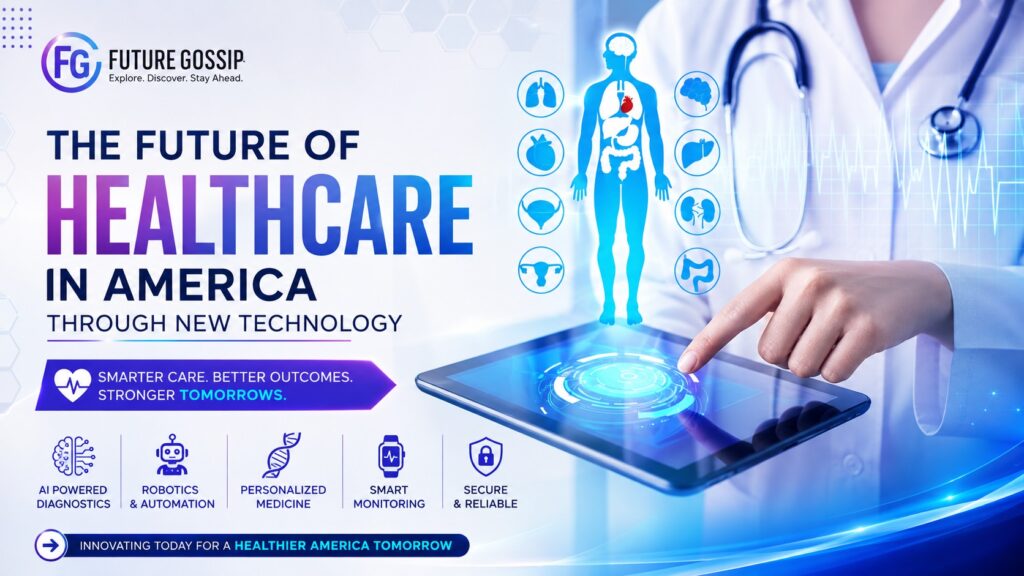
The future of healthcare in America is being shaped by technology that changes how information is collected, analyzed, delivered, and managed. From artificial intelligence and digital health tools to robotics, connected monitoring devices, and personalized medicine, the healthcare technology landscape is moving toward more data-driven and digitally connected systems. Future Gossip explores these developments to help buyers, sellers, retailers, wholesalers, and technology-focused readers understand what is changing and why it matters.
For businesses evaluating healthcare technology products, the important question is not simply whether a product uses AI. Buyers should consider its intended purpose, evidence, usability, interoperability, security, regulatory status where applicable, and the level of professional oversight required. The U.S. Food and Drug Administration maintains information on authorized AI-enabled medical devices, while current health-policy discussions emphasize transparency, governance, bias, data protection, and human oversight.
How New Technology Is Reshaping American Healthcare?
Healthcare technology is no longer limited to futuristic concepts. AI-enabled software, digital monitoring, telehealth platforms, data systems, imaging technologies, and connected devices are already part of the modern healthcare environment. The FDA describes AI and machine learning applications across areas such as image analysis, detection, risk assessment, and personalized diagnostics. This means the practical future is likely to involve a combination of technology and professional decision-making rather than a simple replacement of people by machines.
Artificial Intelligence and Smarter Healthcare Workflows
AI can process large quantities of information quickly and identify patterns that may be difficult to review manually. In healthcare settings, this can support selected administrative, analytical, diagnostic, and monitoring workflows. For buyers, the distinction between a general AI product and a regulated medical device is important. Product descriptions should clearly explain the intended use instead of making broad promises about health outcomes. The FDA continues to develop regulatory and evaluation approaches for AI-enabled medical technologies, reflecting the fact that different applications require different performance assessments.
Robotics and Automation in Healthcare
Robotics is another important part of the changing healthcare technology ecosystem. Robots can be designed for specific operational, surgical, rehabilitation, laboratory, logistics, or assistance-related applications. The key trend is not that every healthcare task will become robotic. Instead, automation is increasingly being developed for defined tasks where precision, repeatability, controlled movement, or operational efficiency can be useful. Buyers should therefore evaluate a robotic product according to its intended function, supporting evidence, training requirements, maintenance needs, and regulatory position.
Personalized Medicine and Data Driven Care
Personalized medicine uses information about an individual to help inform healthcare decisions. Genomic information is one part of this field, while other approaches can involve clinical records, biomarkers, imaging, and other datasets. The broader direction is toward healthcare systems capable of considering more individual information rather than relying exclusively on generalized approaches. However, personalized technology does not mean every consumer product can provide personalized medical guidance. Buyers should distinguish between educational, wellness, monitoring, and clinically intended technologies.
Connected Devices and Remote Monitoring
Connected healthcare devices can collect and transmit information outside traditional clinical environments. Wearable technologies and patient-monitoring systems are examples of how technology can extend observation beyond a single appointment. The FDA notes that AI, automation, and interoperability can support new patient-monitoring capabilities. For sellers, this creates an opportunity to explain compatibility, connectivity, data handling, intended users, and setup requirements clearly instead of relying on vague technology claims.
What Buyers Should Look for in Healthcare Technology
A smart purchasing decision starts with the product’s purpose. Buyers should ask what problem the technology is designed to address, who is expected to use it, what information it processes, whether it integrates with existing systems, and what support is provided. For regulated medical devices, buyers should also verify the relevant U.S. authorization or clearance information where appropriate. The FDA’s public AI-enabled medical device list can help users understand part of the current U.S. landscape, although the agency notes that the list is not comprehensive.
What Sellers Should Explain Clearly
Sellers entering healthcare technology should prioritize accuracy and transparency. Product pages should state intended use, important limitations, technical requirements, compatibility, available documentation, support information, and applicable regulatory information. Avoid statements suggesting that AI or robotics guarantees a diagnosis, treatment result, or improved health outcome. Strong product information helps buyers understand what a technology actually does and reduces confusion between consumer technology and regulated healthcare products.
Privacy Security and Human Oversight
More connected healthcare technology also means more attention to data governance and privacy. Healthcare-related information can be sensitive, so buyers and sellers should understand what data a product collects, where it is processed, how it is protected, and who can access it. Current WHO work on AI in health emphasizes governance, transparency, equity, human oversight, and responsible implementation. These considerations are not secondary features; they are central to evaluating technology intended for healthcare environments.
Fast Delivery and Reliable Product Information
For retail and wholesale buyers, technology is only useful when the purchasing experience is dependable. Clear specifications, accurate product descriptions, stock information, delivery expectations, documentation, and responsive customer support can make technology procurement easier. Future Gossip can serve as a discovery point for readers researching emerging healthcare technology while helping buyers understand the categories, applications, and considerations surrounding products before making a purchasing decision.
Where Healthcare Technology Is Heading Next
The next phase of healthcare technology will likely involve greater integration between AI, connected devices, digital records, automation, robotics, and personalized data. The most meaningful progress will not necessarily come from the most futuristic-looking product. It will come from technologies that solve clearly defined problems, can be evaluated responsibly, fit existing workflows, and provide understandable value to the people using them. Recent WHO work similarly emphasizes implementation, governance, evidence, and responsible adoption rather than technology alone.
Shop and Explore Healthcare Technology Trends with Future Gossip
Whether you are researching healthcare technology for personal interest, evaluating products for a retail operation, sourcing products for wholesale, or exploring emerging categories, use this collection as a starting point. Compare specifications, intended uses, documentation, compatibility, and applicable regulatory information before purchasing. Explore the Future Gossip collection to discover technology-focused products and insights connected to the changing future of healthcare in America.
Browse Future Gossip to discover healthcare technology trends, emerging products, and useful information designed to help buyers and sellers make more informed decisions.
Frequent ask questions, FAQ’s
Buyers can explore technology-focused healthcare product collections, manufacturer information, and product documentation to identify solutions that match their intended use. Future Gossip provides a discovery-focused collection for readers researching emerging healthcare technology. Before purchasing, compare specifications, compatibility, intended users, documentation, and applicable regulatory information.
Check the product’s intended use, manufacturer documentation, technical specifications, compatibility, data requirements, support, privacy information, and applicable U.S. regulatory status. If the product is a regulated medical device, verify the relevant FDA information rather than relying only on advertising language.
Some healthcare technology products are suitable for retail or business procurement, depending on their intended use, regulatory requirements, distribution model, and user environment. Retailers and wholesalers should confirm manufacturer requirements, product documentation, storage or handling requirements, support, and applicable regulations before sourcing products.
Sellers should provide the product name, intended use, specifications, compatibility, technical requirements, limitations, documentation, manufacturer information, support details, and applicable regulatory information. Clear descriptions help buyers understand exactly what the technology is designed to do.
Businesses can monitor AI-enabled medical technologies, connected monitoring devices, digital health platforms, robotics, healthcare automation, interoperability tools, and technologies associated with personalized medicine. Demand will depend on evidence, regulation, usability, adoption, infrastructure, and the specific healthcare setting.
AI is expected to support selected healthcare tasks involving data analysis, medical imaging, monitoring, risk assessment, administration, and decision support. It is more accurate to describe AI as an increasingly important tool within healthcare workflows than as a complete replacement for healthcare professionals. Safe implementation requires appropriate evaluation, oversight, transparency, and monitoring.
Robots are more likely to automate specific tasks than replace healthcare workers as a whole. Robotics can support defined activities involving movement, precision, monitoring, logistics, rehabilitation, or other specialized functions. Human judgment, communication, accountability, and clinical oversight remain important parts of healthcare.
Personalized medicine uses information about an individual to help inform healthcare decisions. Depending on the application, that information can include genomic data, biomarkers, clinical information, or other patient-specific data. Its future role will depend on scientific evidence, appropriate interpretation, data governance, and responsible clinical use.
Connected devices can collect and transmit information that may support monitoring and digital healthcare workflows. Their usefulness depends on the quality of the data, device purpose, connectivity, security, interoperability, and how the information is interpreted. A connected device should not automatically be treated as a medical device simply because it collects health-related information.
Major challenges include data quality, bias, privacy, cybersecurity, transparency, interoperability, changing performance, appropriate validation, regulation, and human oversight. AI systems can behave differently when used with data or populations that differ from their development environment, so ongoing evaluation and monitoring are important.